Showing posts with label arcade. Show all posts

7.20.2011

Game 9: Exed Exes (1985)

Exed Exes, also released under the name of Savage Bees, is the first of many Shoot 'Em Ups we'll be playing over the course of this project, and man does it leave a lot to be desired. The game is extremely rudimentary, and almost crude in it's simpleness. It's not just the graphics; Exed Exes is missing what I have come to consider as basic concept: things like like bullet and enemy patterns, sweet power ups, bombs and massive bosses with glowing weak spots, etc.That being said, this game has some of these elements, just without any of the later sophisiciation and refinement. As a result, it's barely recognizable. For what it's worth, I am in love with Mars Matrix, and generally prefer "bullet hell" over other genres, but grew up playing plenty of Gradius and having exposure to Treasure games and various other classics. We're looking forward to getting to these games, and this served more to whet our appetite than to satiate our hunger.
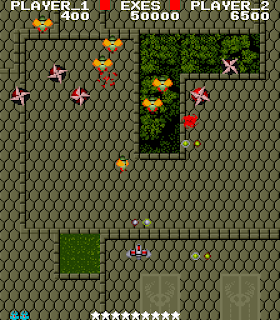
Something is happening that is not happening.

The gameplay and graphics reminded me a lot of Xevious, albeit without the ground targeting, and with more variation in gameplay. I mean this in the sense that there were discrete levels, and the backgrounds and graphics had a generic kind of "future/sci-fi kind of feel." There are a lot of elements that we'll see in later games, but we still are lacking things like "endings." After reading through various pieces online, I found out you can "end" the game by getting 10 million points. We got nowhere near that, and I really don't find this game enjoyable enough to want to plug away at if for that long.

Projectiles, power-ups, and explosions. We have a SHMUP here, boys.

The setting for this game was exciting: after the first four games we played, this felt the most like a modern game. There are discrete and separate terrains, and you get to scroll over them and encounter a variety of enemies. The enemies have a general "insectoid" theme, and that's great. It is more logical and consistent than the crabs and flies of Mario Bros, and less abstract than the knights of Joust. Graphically, the game isn't stunning, but it's not offensive, and shows significant effort. The insectoid theme is echoed in both the enemy designs, and the terrain and background art. This would also explain why this game was released in the US under the name of Savage Bees, a vastly more appropriate name.
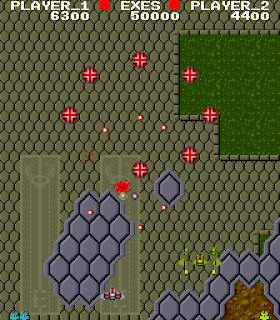
So much geometry.

All of this being said, this game really didn't do it for us. All of the basics of what we crave in Shoot 'Em Ups is there, but the rudimentary feel of the game combined with a lack of real goal or feeling of progression made this game grow tiresome. The basics of cooperative gameplay were there, like many other Shoot 'Em Ups in the future, but we mostly spent the time playing this talking about all the games we'll be playing down the road.

My favorite kind of area.

To be completely honest, I would have never played this game if not for this project. I have not learned anything significant about the growth of the genre or cooperative gameplay. The best I can say about it is that is not offensive and stands as a base to compare later games to. We're still in the category of games before we were born (1985 for me, 1990 for Samchez), and it's frankly a little weird to be in such unfamiliar territory. Looking ahead, we're going to be covering quite a few unfamiliar arcade games, but will soon move into familiar NES territory.

7.18.2011

Game 6: Mario Bros. (1983)

The second game we played, Mario Bros., was by far the most enjoyable game of the first five that we've played. We still haven't hit the era where games are beatable, but just the fact that we do not instantly kill each other is a nice step up from Joust. While I look forward to being able to actually beat a game and be "done" with it, this was still fantastic to play. There are still a lot of weird little things in this game that will change in games over the next few years. For example, there is still no continuing. There is no boss, and you can not change your momentum while in the air. While the inertia in jumping is "realistic," it feels bizarre compared to later control schemes

JUMPUP!!

This game takes place in a Bizarro World version of Mario, where Mario and Luigi have not yet learned how to effectively jump on top of enemies. There are also no mushrooms, flowers, stars, toads, princesses or goombas. Just endless streams of proto-Koopas, flies, and crabs. I am not aware of any explanation of this, nor do I expect one to be forthcoming.

Nothing too bad.

But seriously, this game isn't that hard. Compared to Joust it is a walk in the park, in the sense that we did not needlessly kill each other. There is some awesome teamwork to be had here, in the sense you can bounce an enemy down to your partner and dispatch your foes easily. You can also bounce on each other, although that often comes off as an annoyance more than an asset. There is also competition for getting points, especially during the bonus levels. Points lead to extra lives, and this level competition is fun. The modern age of achievements and multiple game round stat tracking has dulled some of the fun of this; if I do better this round than the last it doesn't reflect anything outside of a development of my own skills.

So many points.

I wish I could say that I don't care about achievements, but this would be a blatant lie. I love to track my stats from round to round of something like Team Fortress 2, for example. It is an addiction, doubtlessly rooted in my love of baseball statistics growing up. The instant gratification that comes from obsessive stat tracking and watching bars fill up is far too rewarding to want to give up. While I appreciate classic games because of their depth of gameplay derived from simple rules, I do feel a lack of the reward treadmill and ending.

Do the Mario!

The sheer weirdness of this game is fun though. I like to imagine how this can be fit into the overall Mario "mythos." I like the idea that this is some kind of endless Karmic purgatory. Maybe this is the true final adventure of Mario: there is no end, there is no princess to kiss. Mario has been sent here for a lifetime of killing and destroying countless Koopa and Goomba lives. This is a sisyphean task set before the Mario Bros. by the gods of the underworld. There is no ending in sight, and the task only grows more difficult as Mario fulfills it. If he doesn't fulfill it fast enough, fireballs come out to attack him, until he finishes the current task, only to start once again on a similar, but slightly harder task. Incidentally, this theory explains 90%+ of the games from this era, where things like "endings" or "goals" were non-existent.

Wrap around hell.

This could also be a chronicle of Mario's death. One day, a plumber goes into the sewers to deal with a nascent turtle infestation, and eventually takes a wrong turn and gets lost. As he goes deeper and deeper into the serpentine corridors, the pungent odors start to affect his thinking, and the turtles appear to be the roughly the same size as him. His eyes, deprived of natural light, begin to see red and green fireballs, and the creatures around him take on unnatural hues. As he delves deeper into the pipes, he begins to see oceanic crabs and flies bigger than he is. Eventually, as he stumbles and slides through the labyrinthine passages, he begins to imagine his locomotive difficulties are caused by rapidly forming ice patches. He begins to hallucinate that he has an identical twin, who dresses and moves the same as he does and occasionally gets in his way. There is only one way out of this: death. Death is a sweet release, and leads to the idea that Super Mario Bros. is the reward. Mario, now in some sort of afterlife, is still entranced with dreams of plumbing, but now dreams in bold colors and creates a narrative to structure his life. His hallucinatory twin no longer is seen at the same time, but still exists to follow Mario's footsteps. I would like to think that the rest of the Mario Universe is the plumber's dying dream, a long hallucination after a treacherous and slow death at the hands of hallucinatory fireballs and flies.

Kick off ALL the pests?

Either way, this game, while featuring Mario and having some basic elements of Mario gameplay (jumping, turtles, enough inertia to slide), is also pretty weird and has a lot of things that won't be seen in a Mario game for years (flies, color coded "mad" enemies, crabs). It is the best game that we've played so far, which isn't saying much, but I would gladly play it again without a second thought.

5.31.2011

Game 3: Joust (1982)

While this may be titled "Game 3," this is actually the first review on the blog. We encountered severe apathy when attempting to play Dungeon and Moria, and perhaps this will change in the future. For now, we are starting off with Joust:

Hal Laboratory shows there used to be no shame in an arcade port.

Joust was originally released for the arcade in 1982, by Williams, and for this review we played the NES release due to technical issues with the original. From what I've read online, despite the 6 year gap in the releases, there are no serious gameplay differences, and we can always come back to the arcade version later when we get it working. I remember renting this game once when I was younger and enjoying it enough not to be mad at picking it, but not enjoying it enough to ever rent it again. Recently, I have had the opportunity to replay it in its arcade glory at Ground Kontrol and it is still painfully easy to die.

Easier said than done.

Joust is really hard. To our modern sensibilities, it feels impossible. We watched the attraction screen that explains the basics, and attempted to start playing. We were killed almost immediately after started, and noted there are no continues or "respawn invincibility," features which we took for granted until playing this. This game also features the contemporary "one-hit kill" style of gameplay. The goal of the game is straight forward: you are a Jouster, and you must kill the other Jousters. When you kill a Jouster, it will hatch an egg that will eventually turn into another Jouster if you do not collect it. There is also friendly fire, making cooperative play a perilous venture.

It starts out simple enough.

 The game starts, like other games of the era, deceptively simple. You (and your friend) are represented by a small blue jouster, and there are some green jousters who spawn and then haphazardly float around. If you defeat all of the jousters in a wave, you progress to the next one. Given that this is an arcade game from 1982, none of this is unexpected. Platforms are removed after certain waves, and the lava will be revealed, giving the player less and less "safe" areas to fly in. Additionally, every few levels, a new enemy will appear. These enemies are generally less idiotic, and more likely to fly towards you rather than get killed by the lava. There is also a "bonus" stage where the screen is filled with eggs that need to be collected before spawning enemy jousters. Because we are still able to kill each other during the bonus stage, we split up the level in terms of layers, to avoid the fatal joust.

Points!

One of the biggest challenges we faced in playing this game cooperatively was each other. The very nature of the game's physics and rules made playing cooperatively a detriment rather than an advantage. We continually killed each other without meaning to, and the quickness of death and lack of continue only adds misery to this plight. At one point we realized that we were having more fun killing each other than trying to get through the waves, and we happily explored that venue for a few lives.

The audio in the NES release is sparse and blippy. The title music is a nice fanfare, but the game is mostly quiet. While this is on par for a 1982 arcade release, it feels dated for a 1988 NES release. The same can be said for the graphics.

In the end, we played the game for about an hour before getting too frustrated and moving on. This puts us over our previously stated 30 minute minimum, but we were unable to achieve our secondary goal of seeing all of the enemies or level variations. As a side note, this is the first game we've played that has a bonus stage, Wikipedia informs me that Galaga included a bonus stage in the previous year